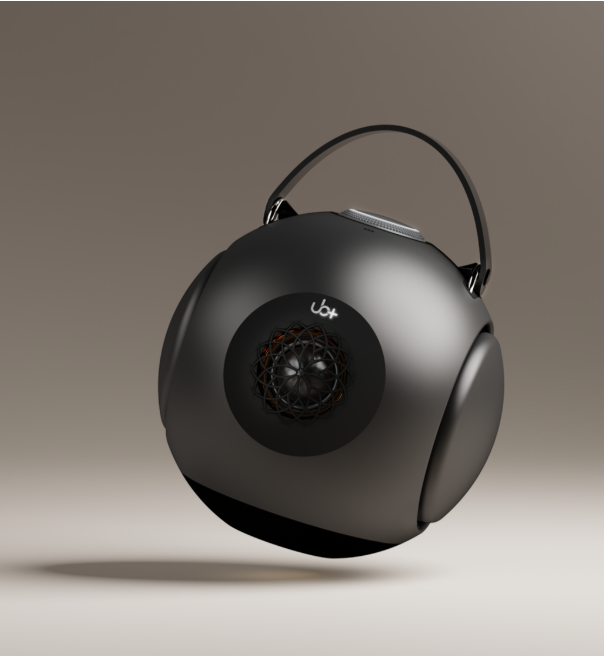
Designed for Depth: Understanding What Makes the Best Wireless Speakers Bass
In the portable audio world, bass is often treated as a spectacle something to impress instantly with sheer intensity. Yet listeners searching for the best wireless speakers bass are usually looking for something more meaningful. They want sound that feels grounded, dimensional, and controlled. They want bass that supports music rather than overwhelming it.
True low-frequency performance is not achieved through louder amplification or aggressive tuning. It is achieved through acoustic balance, structural integrity, and intelligent air movement. The UB+ dB1 DOUBLEBASS was created with this philosophy at its core, redefining how a wireless speaker can deliver depth without compromise.
Why Bass Is the Hardest Frequency to Get Right
Low frequencies require physical displacement of air. Unlike high frequencies, which can be reproduced with minimal motion, bass demands space, stability, and precise control. This is why traditional high-fidelity systems rely on large enclosures.
Portable speakers face the opposite condition: limited internal volume and compact structures. To compensate, many rely on DSP-based boosting, which increases perceived bass but often introduces distortion and imbalance.
The result can include:
- Overemphasized low-end masking midrange clarity
- Cabinet resonance coloring the sound
- Reduced accuracy at higher playback levels
- Listener fatigue from artificially shaped frequencies
UB+ approached the problem differently, focusing on how to generate bass naturally rather than simulate it electronically.
The Helmholtz Resonator: A Classical Principle Reimagined
The design of the dB1 DOUBLEBASS is deeply rooted in the concept of the Helmholtz resonator, a foundational acoustic principle originally developed to analyze and isolate specific harmonics within musical notes. At its simplest, a Helmholtz resonator consists of a closed volume of air with a controlled opening. As air moves in and out of that opening, certain low frequencies are reinforced with remarkable efficiency.
This principle is everywhere in audio design from bass reflex ports to architectural acoustics but it is rarely applied holistically to the shape of an entire enclosure. UB+ saw an opportunity to rethink that relationship.
By translating Helmholtz resonance into a spherical vessel, the dB1 DOUBLEBASS creates an acoustic chamber where internal air pressure is evenly distributed. Instead of fighting resonance, the enclosure shapes it. Standing waves are reduced, phase distortion is minimized, and harmonic reproduction becomes cleaner across low and mid frequencies.
The sphere is not an aesthetic shell placed around a speaker.
It is the speaker.
For listeners, this means bass that integrates seamlessly into the musical structure, preserving clarity while delivering weight.
A Spherical Enclosure That Works With Sound, Not Against It
Unlike rectangular cabinets, which introduce parallel walls and uneven reflections, a sphere distributes acoustic pressure uniformly. This eliminates localized resonance and allows energy to flow smoothly.
The enclosure becomes a controlled acoustic environment, enabling efficient air movement while maintaining tonal neutrality. The design allows bass to develop naturally instead of being forced through small ports or digitally exaggerated.
Dual Passive Radiators for Symmetrical Motion
Inside the dB1 DOUBLEBASS, a centrally positioned mid-bass driver fires inward into the spherical chamber. Two large passive radiators are mounted opposite each other, forming a balanced mechanical system.
When music plays:
- Internal air pressure builds evenly
- Both radiators move outward simultaneously
- Motion remains symmetrical
- Mechanical vibration cancels itself
This self-cancelling behavior ensures that energy is directed into sound rather than cabinet movement, producing bass that feels controlled and stable.
Mechanical Amplification Instead of Digital Boosting
The combined passive radiator surface area is approximately 3.5× larger than the woofer, enabling the system to move more air efficiently. Instead of relying on DSP to create artificial depth, the dB1 uses airflow to amplify naturally.
This approach allows bass to remain clean, even at higher volumes, avoiding the distortion commonly associated with compact wireless speakers.
A Driver Engineered for Precision
At the center of the system is a 4.5-inch woofer built with high-end components:
- 90mm neodymium magnet providing strong motor control
- 35mm long-stroke voice coil supporting extended excursion
- Up to 20mm piston movement enabling powerful response
- Aluminum shorting ring reducing distortion
- Wide surround maintaining linear motion
These features allow the driver to operate efficiently while preserving clarity across the frequency spectrum.
Dual Driver Configuration for Harmonic Stability
Using two drivers distributes acoustic load. This lowers distortion, improves headroom, and prevents driver over-excursion. Harmonic reproduction becomes cleaner, preserving midrange detail and maintaining separation between instruments.
Phase Coherence and Imaging
Accurate bass supports spatial perception. When low frequencies arrive out of phase, imaging collapses. The dB1’s structural symmetry and driver alignment promote coherent wave propagation, enhancing stereo performance when paired.
DSP as Structural Support
Digital processing monitors system behavior but does not artificially inflate bass. It ensures linearity, protects components, and maintains tonal balance as volume increases, reinforcing the mechanical design.
Performance Across Environments
Bass often disappears outdoors due to lack of boundary reinforcement. The dB1’s acoustic chamber design generates sufficient controlled pressure to maintain low-frequency presence in open spaces, while remaining balanced indoors.
Transmission Quality and Signal Integrity
Bluetooth 5.3 ensures stable connectivity and low latency, preserving dynamic detail. Wired and TF playback provide alternatives for consistent performance across listening scenarios.
Power Delivery for Low Frequencies
Producing bass requires energy. Efficient power management allows up to 20 hours of playback without sacrificing dynamic performance, supporting extended listening without compromise.
Stereo Pairing for Expanded Soundstage
Two units create a broader acoustic image with greater depth and separation. Because each speaker maintains phase integrity, stereo playback feels immersive and natural.
Structural Rigidity and Material Integrity
A rigid enclosure prevents vibration-induced distortion, maintaining acoustic precision over time. The spherical structure distributes stress evenly, ensuring durability and consistent sound reproduction.
What Truly Defines the Best Wireless Speakers Bass
Authentic bass performance depends on multiple interconnected factors:
- Enclosure geometry
- Air volume management
- Driver configuration
- Resonance control
- Phase alignment
The dB1 DOUBLEBASS integrates these elements into a unified acoustic system, allowing each component to enhance the others.
Designed by Physics, Not Presets
Many portable speakers attempt to simulate depth through processing. The UB+ dB1 DOUBLEBASS demonstrates that thoughtful engineering can produce deeper, more natural bass through structure alone.
Not boosted bass. Engineered bass.
This philosophy results in sound that remains engaging and balanced over time, avoiding the fatigue associated with artificially enhanced playback.
A Wireless Speaker That Thinks Like a Hi-Fi System
For listeners seeking the best wireless speakers bass, the answer lies not in louder output but in smarter acoustic design. The dB1 transforms compact dimensions into a refined system capable of delivering depth, clarity, and consistency.
It is a speaker built on physics, guided by precision engineering, and designed to let music unfold naturally.